






合作出成果:从大型项目到中等规模的成功。.
在建立良好声誉的同时,我们的目标是展示我们为中型项目提供高性价比解决方案的能力,向客户传授最新技术,确保他们取得长期成功。我们优先考虑与客户建立关系,而不仅仅是客户,经常与机场规划和开发部门的小型团队密切合作,以提供卓越的成果。.

The Baggage Handling System (BHS) at Seattle-Tacoma International Airport had seven separate Checked Baggage Inspection Systems (CBIS) in operation, with very little redundancy between systems. The Port retained BNP to redesign the system to accommodate 66 Million Annual Passengers (MAP) due to rapid growth.

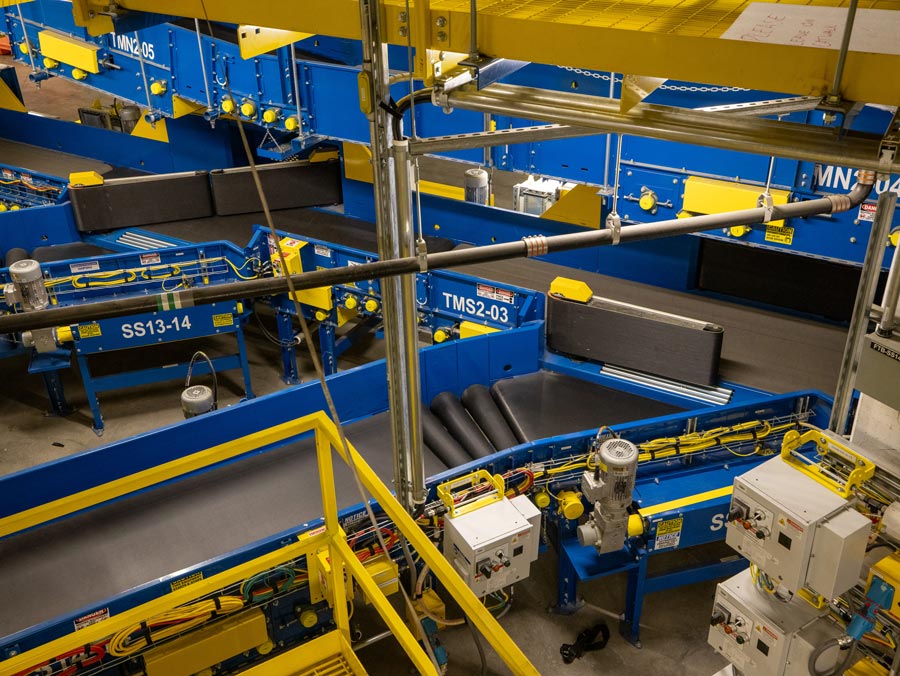
The Baggage Handling System (BHS) at Seattle-Tacoma International Airport had seven separate Checked Baggage Inspection Systems (CBIS) in operation, with very little redundancy between systems. The Port retained BNP to redesign the system to accommodate 66 Million Annual Passengers (MAP) due to rapid growth. BNP primed the project as the Designer of Record with Gensler, Mazzetti, and Exeltech subcontracted for specialty services.
Multiple products were tested for energy cost reduction. The data was compared to the manufacturer’s claims and the airport’s existing equipment to determine long-term energy savings gained. Along with input from the Port’s O&M staff, the BHS equipment specifications were updated. The overall project will remove and replace over 10 miles of conveyor.
Phase 1 construction began in March 2017 and concluded in April 2020. It consisted of eight CTX 9800 machines, 28 baggage inspection tables, one temporary MEC, and two temporary sortation mainlines. It utilized 690 drives with distributed I/O controls, run-on-demand energy management, and the ability to bypass the C1 CBIS.
Instead of conventional controls methodology using Motor Control Panels, the distributed controls architecture consists of Motor Power Panels that provide 480VAC power to the drives and Conveyor System Controllers that communicate with the field devices via Ethernet. Conventional pipe and wiring are used for the 480VAC power. All control wiring utilizes Ethernet or low-voltage cabling run in cable trays along the side of the conveyors.
This significantly reduces electrical installation time and labor costs, providing plug-and-play operation for replacement components. With run-on-demand methodology, each individual conveyor runs only when a bag is approaching or the conveyor is occupied. Once the conveyor is clear, the conveyor stops and remains in a ready state. Run time can be configured to any value and can be set by individual conveyor, sub-system, or globally.
Phase 2 of the project added four additional EDS machines (with the capability to add four more) to the centralized CBIS. It added fourteen new Bag Inspection Tables (BITs), with the ability to add an additional 16, to the centralized CBRA. It also added four manual encode lines, new sortation to the north concourse, and new mainlines to the south connecting to the south satellite.
Construction of Phase 2 was completed in 2024. Phase 2 introduced over 2,200 new drives with distributed I/O controls and run-on-demand energy management. When completed, four of the seven CBISs were eliminated.
Phase 3 aims to connect the south ticket counters to the centralized CBIS, add three additional EDS machines and seven BITs in the centralized CBIS, add four sortation mainlines, two manual encodes, two recirculation lines, two additional makeups in the south bag room, and final connections to the SSAT tunnel and International Arrivals Facility. Phase 3 is designed to eliminate the remaining three CBISs, and construction is scheduled to begin in 2025.
2013
Port of Seattle
北美

北美
As an essential member of the PCL Construction Design-Build (DB) team, Studdiford Technical Solutions, LLC (STS) provides BHS subject matter expertise for the TSA Recapitalization and Baggage Handling System (BHS) Modernization program.
北美
As a member of the BHS design‑build team, Studdiford Technical Solutions, LLC (STS) provided BHS subject matter expertise, design oversight, system integration support, and commissioning services for the South Terminal.
北美
Studdiford Technical Solutions, LLC (STS) managed the modernization of the Terminal 2 baggage handling system through controls upgrades, commissioning, and implementation oversight.
BNP Associates, Inc. 是为航空运输和物流业提供专业咨询服务的全球领先企业。.