Übersicht
BNP Associates offers design and modeling analysis services for the development of airport checkpoint facilities. BNP collaborates with architectural design firms to create comprehensive checkpoint design solutions. They actively participate in working group meetings with the US Transportation Security Administration (TSA) to develop the TSA’s Checkpoint Requirements and Planning Guide.
Past Projects and Capabilities
Past projects have included evaluating checkpoint redesign requirements for Terminals A, B, C, and E at Boston International Airport, and developing a Checkpoint Modeling Tool for a major Automated Screening Lane (ASL) manufacturer. This tool allows them to identify queuing requirements and passenger and baggage throughput as various lane parameters are modified, such as:
- Distribution of demand to the checkpoint (flight schedule-based or peak flow rates)
- Type of lane (Regular vs. Automated Screening Lane ASL)
- Number of divest positions
- Number of recompose positions
- Baggage review throughput/processing times (initial screening)
- Number of agent positions for resolving baggage alarms
- Distribution of time to resolve bag alarms
- Passenger screening configuration (WTMD, ASL)
- Number of screening agents
Screening Technologies
Checkpoints incorporate different technologies for screening carry-on luggage. Typical equipment and services for screening items at the checkpoint include:
- X-ray technology
- CT-based screening
- Inspection using canines
- ETD screening (for resolution of X-ray or CT alarms)
Passengers are generally screened using:
- Conventional Walk-Through Metal Detectors (WTMDs)
- Advanced Imaging Technology (AIT)
Lane Configuration and Requirements
Lanes may utilize multiple technologies, and different security protocols may apply (e.g., low-risk passengers may have different requirements for divesting computers and shoes). Queueing is often partitioned into different areas for low-risk passengers (pre-check), frequent travelers (airline priority passengers), regular passengers, and employees/crew. Additional requirements may include accommodation for wheelchairs.
BNP works closely with airports and stakeholders to understand the specific technologies that will be utilized and to ensure that the checkpoint is appropriately sized to handle the expected design-day traffic loads.
Nachfrageprognose
To determine the requirements for Security Screening Checkpoints, a demand forecast is essential. BNP specializes in developing these demand forecasts based on projected flight schedule activity, expected growth, and the arrival patterns of passengers to the checkpoint areas. BNP can characterize passenger arrival behavior through on-site surveys to establish arrival patterns or by incorporating existing airport or air carrier arrival profiles into their forecasting system.
Checkpoint Modeling
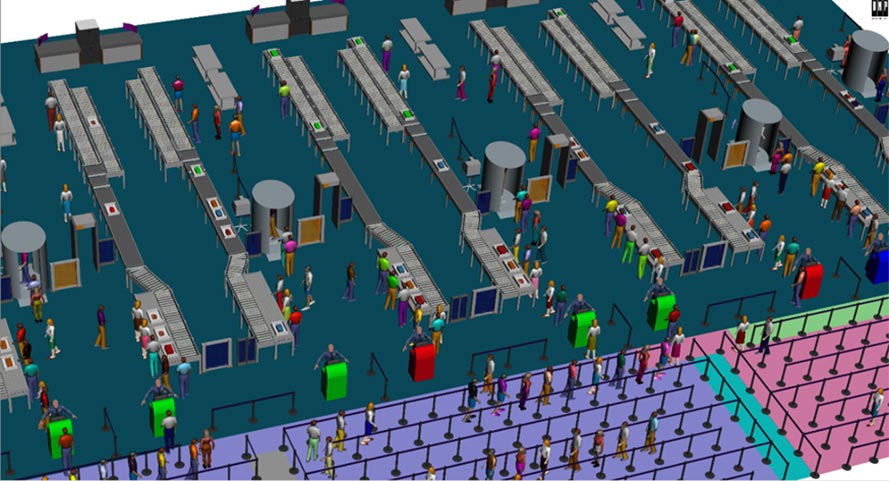
BNP utilizes both high-level and detailed 3D discrete-event simulation modeling to quantify the performance of checkpoints. These models help determine:
- The number of lanes required
- Expected queuing
- Expected passenger wait times
- Impact of screening protocol and throughput rates
- Impact of variable lane openings and staffing